

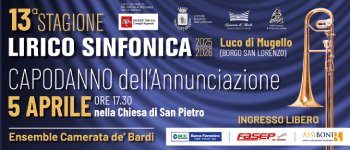

LUCO DI MUGELLO (BORGO SAN LORENZO) – It should be noted how remarkable the former monastery is still today, but unfortunately is threatened from degradation, and from an imminent final destruction like the beautiful cloister. At the end of the broad garden there is a small chapel, that was undoubtedly stage of a prayer itinerary; inside there is a fresco on the altar with a scene of “Noli me tangere” and the Crucifixion: the style seems to be attributed to the work of an active painter engaged with the so-called “Scuola di San Marco”, in the early decades of the sixteenth…
Author: RedFilo Cultura
BORGO SAN LORENZO (The church of San Pietro in Luco di Mugello) – Its gabled façade still has the beautiful original Renaissance portal, whose lunette that houses a majolica with the Madonna and Child, work of the Fornaci San Lorenzo of the Manifattura Chini (1932), was placed on the occasion of the restorations of that period. Inside, there is a significant nucleus of works of art with the same size of the biblical temple of Solomon in Jerusalem, characterized by the large and elegant apse with refined Renaissance decorations in stone: above the main altar, dating back to 1630, stands…
© Il Filo – Idee e Notizie dal Mugello
BORGO SAN LORENZO – According to tradition, the Ubaldini Da Ripa donated the pre-existing church of Sant’Andrea to Saint Francis and the poor, which was outside the castle of Borgo San Lorenzo, in the direction of Vicchio and then founded the adjacent Franciscan convent, following his visit to the town. During the XIII century, the convent community grew and was the object of numerous legacies and donations: one above all the donation in 1245 of a land by Ardingo, bishop of Florence, or another by Folco Portinari, father of Beatrice Portinari, the well-known Beatrice of Dante, dating back to 1287.…
LUCO DI MUGELLO (BORGO SAN LORENZO) – Outside the monastic complex, at the intersection of road that leads to Grezzano, stands the pretty little temple dedicated to the “Divina Pastora”, a small relief in polychrome majolica from the workshop of Giovanni della Robbia (1520-1530 ca.) and the object of intense devotion from the local population. The building, a hexagonal plant with a central dome and ambulatory, dates back to its original layout in 1583: this differed from the current one due to the fact that the ambulatory was open to the outside and only in 1830 church. Outside, the linear geometry…
ù GREZZANO (BORGO SAN LORENZO) – While the Grezzano town is remembered by documents since 1037 as the feud of Guidi Counts, the existence of the church of S. Stefano can be already found in 1086, when its rector was nominated. Also, the book of Montaperti mentions the church of S. Stefano in Grezzano. In 1508, the church of S. Stefano became part of the heritage of the Florentine Spedale di S. Maria Nuova, with the right, among other things, to appoint the priory. Apart from the details mentioned above, the historical information about the Church are scarce; at the…
BORGO SAN LORENZO – The monumental and solemn municipal building, which acts as a wide background of the airy Piazza Dante, is the result of the design and decoration work of Tito Chini, who worked there from 1926 to 1931 with the collaboration of the famous Manifattura Delle Fornaci San Lorenzo, active at Borgo since 1906. The façade, characterised by large architectural windows and a long balcony supported by massive ashlar columns, was completed only during 1937. The interior decoration of the building, as well as the shape of its structure would hide, according to a recent interpretation, a complex…
BORGO SAN LORENZO – The medieval Palazzo del Podestà, which now houses the municipal library, probably dates back to the mid-thirteenth century, and was originally the seat of political authority (precisely the Podestà) sent from Florence every six months. Over the centuries the building had known several interventions that had altered its appearance. Already at the beginning of the last century the building appeared in precarious conditions, conditions that worsened further during the disastrous earthquake of the 29th of June, 1919. The Cassa di Risparmio di Firenze, then presided over by the general Guglielmo Pecori Giraldi, satisfied the need to…
© Il Filo – Idee e Notizie dal Mugello
© Il Filo – Idee e Notizie dal Mugello

