



The foundation of the convent and the church of San Carlo, held by the Capuchin order, dates back to the early 1600s on the initiative of some gentlemen from Florence, who owned estates in Mugello and who in 1612 asked the “Podesteria” of Borgo San Lorenzo a place where they would have provided themselves for the construction of the new convent entrusted to the Capuchins.
On the architrave of the entrance door of the church, above which is also painted a small head of St. Francis, “in memory of the Count Giovanni Collalto”, there is an inscription dated 1613, stated as the year of its foundation by Florentine nobles: “THIS CONVENT WAS MADE THANKS TO MORE PEOPLE AND SEVERAL OFFERS”.
On the right side of the entrance portal of the church, there is the commemorative plaque of the Franciscan Centenary: this is the first example, the prototype, produced in 1925 by the Chini Manufacture, based on a design by Augusto Chini. To the right of the facade, in a protected niche, there is a sculpture depicting a Piets in glazed terracotta, the work of the sculptor Guido Calori and produced in 1939 by the Chini furnaces of Borgo San Lorenzo.

The church was recently restored in a sober and elegant style harmonized well with the severe simplicity of a Franciscan church, with a single hall ending in an apse.

 Internally, on the high altar, a delicately crafted Crucifix is placed over a painting depicting the Pious Women and Saints, all framed by a beautiful carved altarpiece in wood. Inside the church there is also a Holy Family, attributed to the Ghirlandaio’s school and a “paliotto” and a chasuble of wool embroidered with cotton and gold.
On the left side there are two chapels, today dedicated to the Madonna and to St. Francis. In the latter, two side niches contain the statues of St. Louis King of France and St. Elizabeth Queen of England.
 Adjacent to the church, on the left side, there is the Cenacle of the Franciscan Third Order, designed by Chino Chini and inaugurated in 1926, for the centenary celebrations of the saint’s death, which bears on the facade a ceramic lunette depicting the symbol of the order: Christ’s arm crossed with that one of St. Francis on the Cross. Inside the building, there is a rich sample of the production of the Chini manufacture, polychrome stained glass windows and noble ceramic coats of arms, among which a pulpit resting on decorated corbels and covered in polychrome tiles with the Franciscan symbol of the Tau, placed between two musician angels.
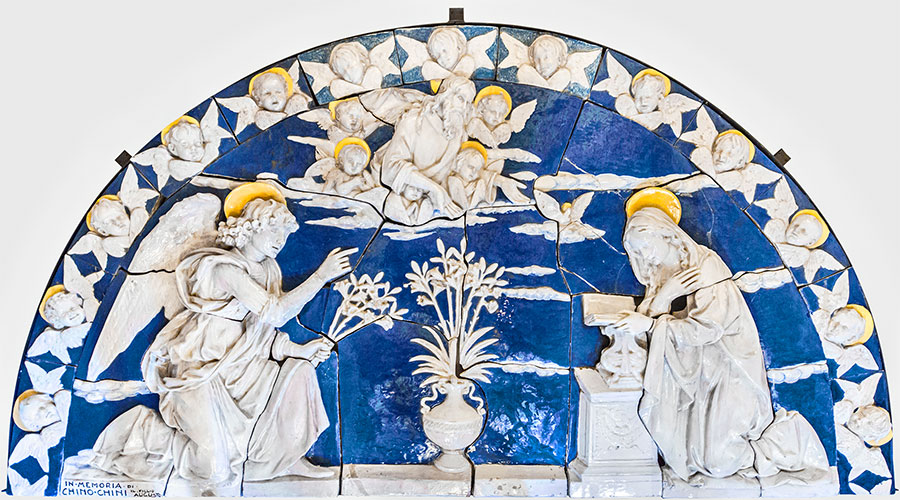 On the back wall of the refectory, there is a beautiful glazed majolica inspired by Della Robbia and representing the Annunciation, dated 1912, surely by the Chini Manufacturers.
© Il Filo – Idee e Notizie dal Mugello

